Invasive plant
Japanese knotweed
Reynoutria japonica
Japanese knotweed identification: hollow jointed stems, squared leaf bases and deep rhizomes. It resembles bamboo but has herbaceous stems.
Published Last reviewed
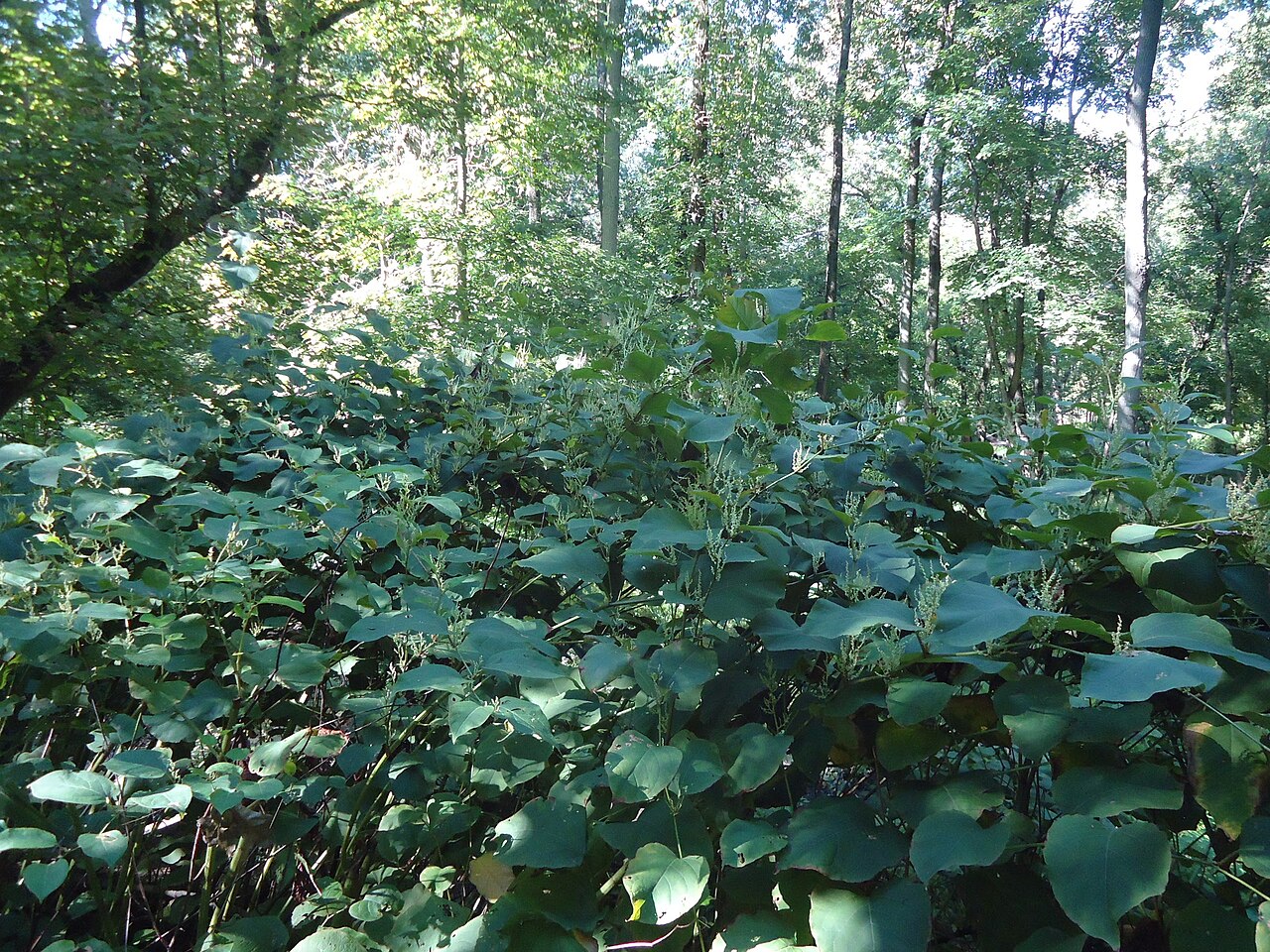
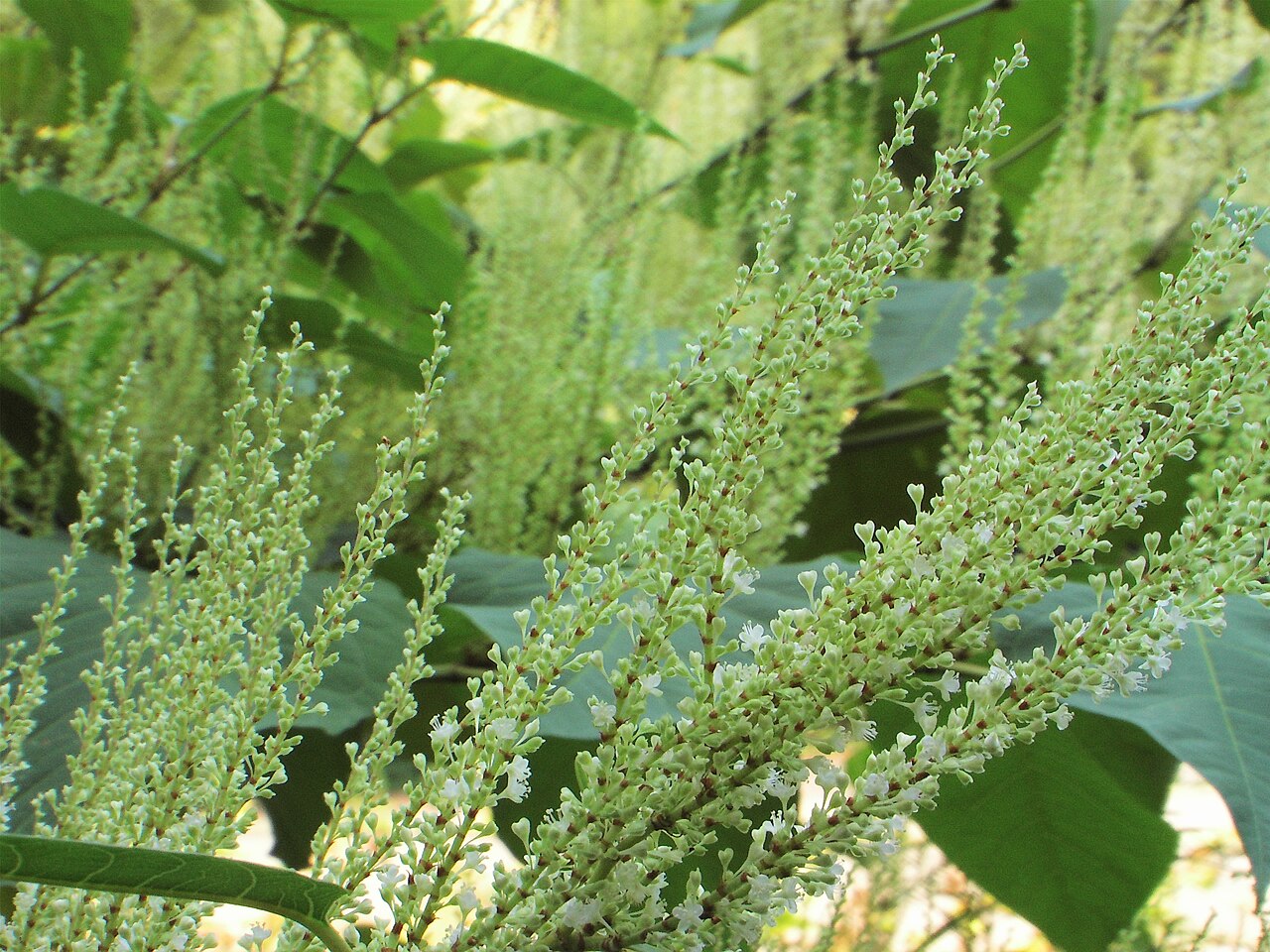
Japanese knotweed was introduced from East Asia in the late 1800s as an ornamental and to stabilize stream banks. It is an herbaceous perennial in the buckwheat family and is now established in wetlands, stream corridors, forest edges and drainage ditches across the country. Giant knotweed and the hybrid Bohemian knotweed look similar and complicate identification.
Identification
Look for the combination of characters below. A single feature is rarely enough, especially when a native look-alike is present.
- Height and habit
- Grows up to 11 feet tall and forms dense thickets. The stems are jointed and hollow, superficially resembling bamboo.
- Stems
- Bright green and smooth when mature, with red or purple nodes and darker spots or streaks. Leaf-bearing sections zigzag from node to node.
- Leaves
- Alternate, spade- or heart-shaped and up to 6 inches long. The leaf base is squared off, which helps separate it from giant and hybrid knotweed.
- New shoots
- Emerging in early spring, bright red or purple and tipped with furled, distinctly triangular leaves.
- Flowers
- In late summer, white or pale green finger-like clusters 3 to 4 inches long, made up of many small five-petaled flowers.
- Roots and rhizomes
- An extensive network of horizontal underground stems. Small fragments can produce new plants, and cut stems can regrow if they remain in moist soil.
Look-alikes
-
Bamboo
Bamboo has slender, papery leaves that persist year-round and woody, jointed stems. Living knotweed stems are herbaceous and visibly wet when cut.
-
Giant knotweed and Bohemian knotweed
Reynoutria sachalinensis and Reynoutria × bohemica
Giant knotweed leaves can reach 1 foot and have a rounded base; Japanese knotweed leaves are smaller with a squared base. The two species form the hybrid Bohemian knotweed.
-
Broad-leaved dock
Rumex obtusifolius
Broad-leaved dock grows as a rosette of basal leaves from a central taproot, while Japanese knotweed sends up many single, rapidly elongating stems.
Range and status
Native range: East Asia
Regulatory status by state
-
Pennsylvania Noxious weed
Japanese knotweed is a Class B noxious weed on the Pennsylvania Department of Agriculture list. Noxious weeds cannot be sold, transported, planted or otherwise propagated in the state. Class B means the plant is widely established and cannot feasibly be eradicated.
-
New York Prohibited
Japanese knotweed is prohibited under 6 NYCRR Part 575. Prohibited plants cannot be sold, imported, purchased, transported, introduced or propagated in New York.
-
Virginia Noxious weed
Japanese knotweed is a Tier 3 noxious weed in Virginia under 2VAC5-317-20. Moving a listed noxious weed requires a valid certificate or permit.
-
ohio Noxious weed
Japanese knotweed is a prohibited noxious weed under OAC 901:5-37-01, which requires management on public and private property. It is also on Ohio's invasive plant list under OAC 901:5-30-01.
-
wisconsin Restricted
Wisconsin classifies Japanese knotweed as Restricted under NR 40. Restricted species cannot be transported, transferred or introduced without a permit; control is encouraged but not required.
Why it matters
Dense knotweed thickets shade out other vegetation and form monocultures. Along streams, the plant provides poorer erosion control than native vegetation and can degrade aquatic habitat and water quality. Rhizomes can also damage road and bridge foundations and other infrastructure.
Management
Plan for more than one season
Control aims to exhaust the rhizome system. Penn State Extension describes an initial control phase of at least two seasons, followed by monitoring and retreatment of any new growth.
Cutting alone is not enough
Timing: Cut in June, then wait at least eight weeks.
Cutting without a follow-up treatment is not an effective suppression approach. If you cut, do it in June and wait at least eight weeks before treating the shorter regrowth with herbicide; treating too soon reduces movement of the herbicide to the rhizomes.
Late-season systemic treatment
A systemic herbicide applied late in the season moves with sugars to the roots and rhizomes. Penn State Extension recommends glyphosate, including aquatic-labelled products near water, and notes that imazapyr has soil activity that can injure nearby trees. Follow the product label and state law, and confirm the approach with your extension service.
Contain rhizome and stem fragments
Rhizome pieces and cut stems can start new plants. Do not move soil containing roots, and bag or contain plant material for disposal according to state and local rules.
Sources
Facts on this page were checked against the sources below. Each link shows the date the source was accessed.
- Japanese Knotweed — Penn State Extension Accessed November 3, 2026
- Reynoutria japonica Houtt. (Japanese knotweed) — USDA NRCS PLANTS Database Accessed November 3, 2026
- 7 Pa. Code Chapter 110. Noxious Weeds — Pennsylvania Code Accessed November 3, 2026
Related pages
-
Giant Knotweed vs Japanese Knotweed: The Leaf Test
Giant knotweed vs Japanese knotweed: a heart-shaped leaf base and leaves over 6 inches point to giant; a squared base points to Japanese.
-
Japanese Knotweed vs Bamboo: How to Tell Them Apart
Japanese knotweed vs bamboo: knotweed is herbaceous, hollow and dies back in winter; bamboo is woody and keeps its papery leaves.
-
How to Dispose of Invasive Plants Safely
How to dispose of invasive plants: bag roots, tubers and seed heads, solarize the sealed bags, then trash them. Do not compost or send them to yard waste.
-
How to Get Rid of Invasive Plants Without Chemicals
How to get rid of invasive plants without chemicals: pull, dig, cut on a schedule, smother or solarize. Where vinegar and boiling water fall short.
-
How to Get Rid of Invasive Plants: A Step-by-Step Guide
How to get rid of invasive plants: identify it, check state rules, choose a method by root type, dispose of every fragment, then monitor regrowth.
-
How to Remove Japanese Knotweed Without Spreading It
How to remove Japanese knotweed: treat the rhizome system over several seasons, cut before spraying, and contain every fragment.
-
Spring Invasive Plants Checklist: What to Look For in March, April, May and June
Spring invasive plants checklist: what to look for and act on each month from March through June, with links to species and removal guides.
-
When to Treat Invasive Plants: A Seasonal Calendar
Best time to spray invasive plants: late summer to early fall for woody plants and late-season perennials. Spring ephemerals need early spring instead.
-
New York regulation and reporting
Invasive plants in New York: 6 NYCRR Part 575 prohibits 69 plants and regulates six others, which may still be sold with a warning label.
-
Pennsylvania regulation and reporting
Invasive plants in Pennsylvania are listed in three noxious weed classes. Class B includes Japanese knotweed, tree of heaven and garlic mustard.
-
Virginia regulation and reporting
Invasive plants in Virginia sit in three noxious weed tiers that restrict movement. A separate DCR list is advisory and has no regulatory authority.