Invasive plant
Tree of heaven
Ailanthus altissima
Tree of heaven identification: long compound leaves with smooth edges and a gland at each leaflet base, pale bark and a strong odor when crushed.
Published Last reviewed
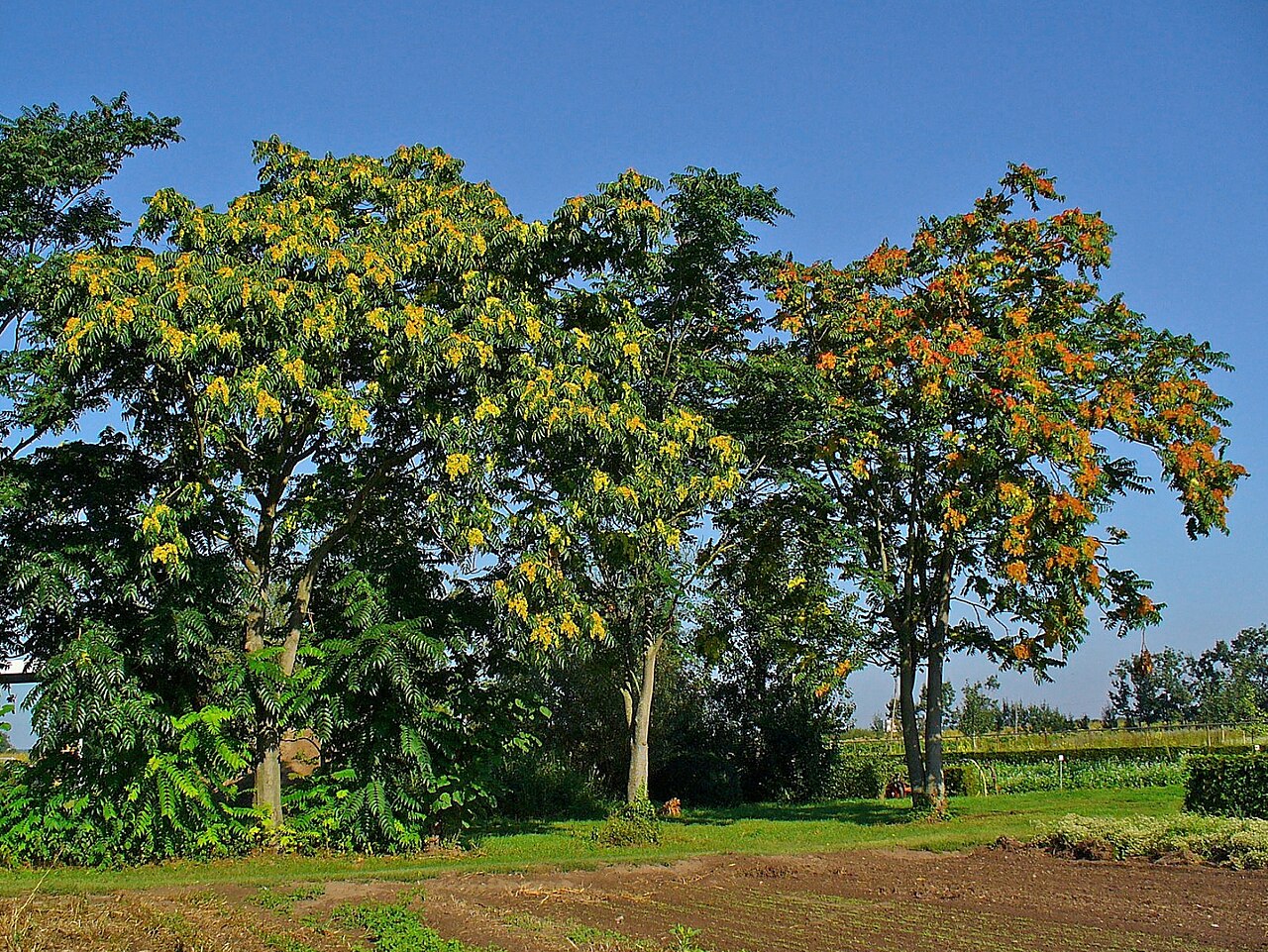
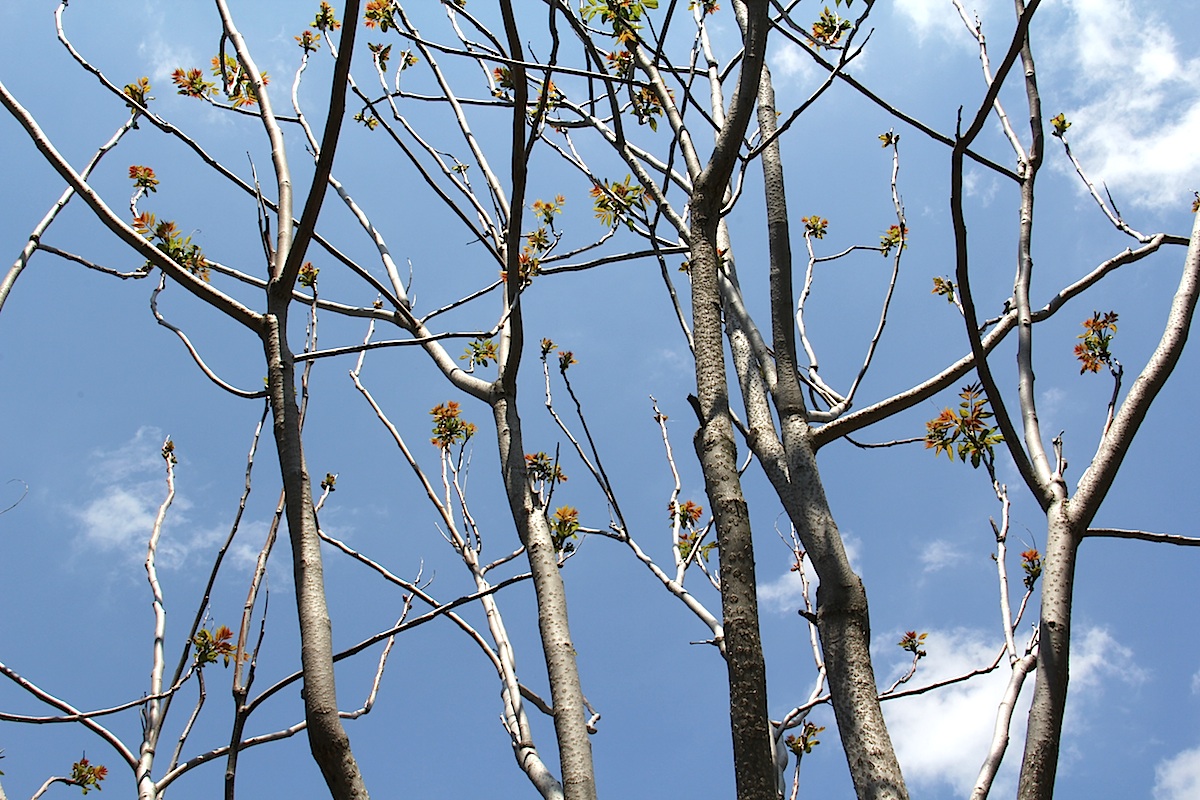
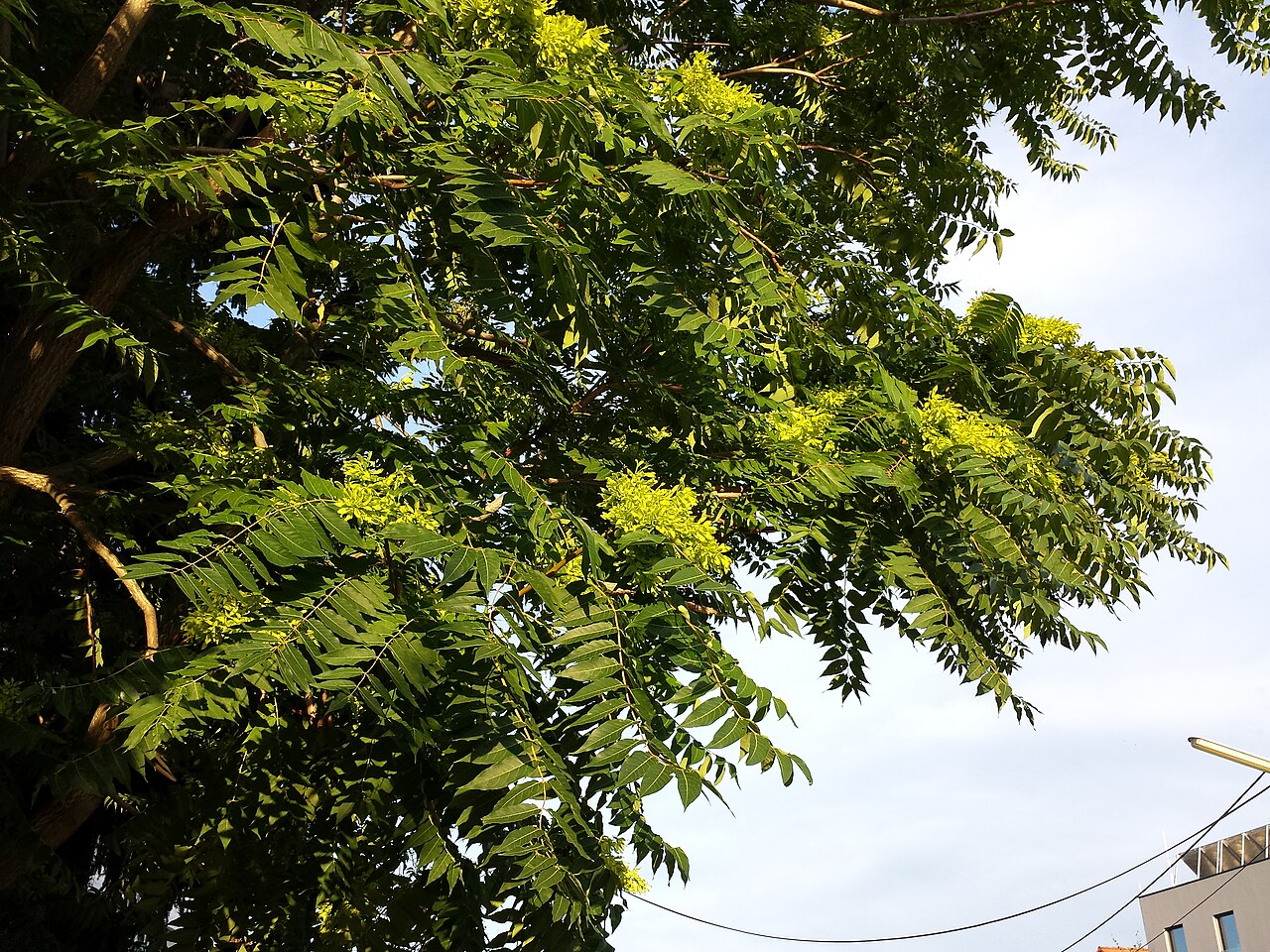
Tree of heaven is native to northeast and central China and Taiwan. It was first introduced to the United States in the Philadelphia area in the late 1700s and later reached the West Coast in the 1850s. It was planted as a fast-growing ornamental shade tree before its weedy nature, prolific root sprouting and foul odor made it unpopular.
Identification
Look for the combination of characters below. A single feature is rarely enough, especially when a native look-alike is present.
- Size and bark
- Can reach 80 feet tall and up to 6 feet in diameter. Young bark is smooth and brownish-green; older bark turns light brown to grey and resembles the skin of a cantaloupe.
- Leaves
- Pinnately compound leaves 1 to 4 feet long, with 10 to 40 lance-shaped leaflets. Leaflet edges are smooth rather than toothed.
- Glandular teeth
- One or two protruding bumps, called glandular teeth, sit at the base of each leaflet. This is the decisive character against native look-alikes with serrated leaflets.
- Odour
- Crushed leaves, twigs and other plant parts give off a strong, offensive odor.
- Twigs and pith
- Twigs are alternate, stout and lack a terminal bud. They have large V- or heart-shaped leaf scars and break easily to expose a large, spongy brown pith.
- Seeds
- Female trees produce twisted, 1- to 2-inch samaras in clusters that often hang on the tree through winter. A single tree can produce more than 300,000 seeds a year.
Look-alikes
-
Staghorn sumac
Rhus typhina
Staghorn sumac has serrated leaflet edges and red, fuzzy fruit clusters. Tree of heaven has smooth leaflet edges, glandular teeth at the leaflet base and a foul odor when crushed.
-
Black walnut
Juglans nigra
Black walnut leaflets are serrated and the tree produces round, green-husked nuts. Tree of heaven leaflets are smooth-edged and the seeds are winged samaras.
-
Hickory
Carya species
Hickory leaves have serrated leaflets and the trees produce nuts. Tree of heaven has smooth leaflets, glandular teeth and a spongy brown pith in the twigs.
Range and status
Native range: Northeast and central China, and Taiwan
Regulatory status by state
-
Pennsylvania Noxious weed
Tree of heaven is a Class B noxious weed on the Pennsylvania Department of Agriculture list. Noxious weeds cannot be sold, transported, planted or otherwise propagated in the state. Class B means the plant is widely established and cannot feasibly be eradicated.
-
new-york Not on the state noxious-weed list
Tree of heaven is not on the 6 NYCRR Part 575 prohibited or regulated plant list.
-
virginia Noxious weed
Tree of heaven is a Tier 3 noxious weed in Virginia under 2VAC5-317-20. Moving a listed noxious weed requires a valid certificate or permit.
-
ohio Prohibited
Tree of heaven is on Ohio's invasive plant list under OAC 901:5-30-01, which bans selling, propagating, distributing, importing or intentionally spreading it.
-
wisconsin Restricted
Wisconsin classifies tree of heaven as Restricted under NR 40. Restricted species cannot be transported, transferred or introduced without a permit; control is encouraged but not required.
Why it matters
Tree of heaven grows rapidly, produces abundant wind-dispersed seed and spreads aggressively by root suckers. It also releases allelopathic chemicals from its leaves, roots and bark that can limit or prevent other plants from establishing. Dense clonal patches displace native vegetation in urban areas, roadsides, fencerows and forest openings.
Management
Cutting alone usually makes the problem worse
Mechanical methods such as cutting or mowing are ineffective on their own because the tree responds with large numbers of stump sprouts and root suckers. If a hazardous tree must be cut, Penn State Extension advises treating it with herbicide first, waiting about 30 days for symptoms to develop, and then cutting.
Treat when carbohydrates move to the roots
Systemic herbicide applications are most effective from mid- to late summer, roughly July until the onset of fall color, when the tree is moving carbohydrates to its roots. Applications outside that window may injure aboveground growth without controlling the root system.
Choose a method that reaches the roots
Foliar, basal bark and hack-and-squirt applications can all reach the root system. Penn State Extension does not recommend cut-stump herbicide treatment because it does not prevent root suckering. Follow the product label and state law, and confirm the approach with your extension service.
Hand-pull only true seedlings
Young seedlings can be hand-pulled when the soil is moist if the entire root system comes out. Small root fragments can still produce new shoots, and seedlings are easily confused with root suckers, which are nearly impossible to pull by hand.
Expect to return
Well-established stands are only eliminated through repeated treatment and monitoring. Initial treatments often only reduce the root system, so plan follow-up work in later seasons.
Sources
Facts on this page were checked against the sources below. Each link shows the date the source was accessed.
- Tree-of-Heaven — Penn State Extension Accessed November 3, 2026
- Ailanthus altissima (Mill.) Swingle (tree of heaven) — USDA NRCS PLANTS Database Accessed November 3, 2026
- 7 Pa. Code Chapter 110. Noxious Weeds — Pennsylvania Code Accessed November 3, 2026
Related pages
-
Tree of Heaven vs Sumac: How to Tell Them Apart
Tree of heaven vs sumac: smooth leaflets with a gland at the base and winged seeds mean tree of heaven; toothed leaflets and red berries mean native sumac.
-
How to Dispose of Invasive Plants Safely
How to dispose of invasive plants: bag roots, tubers and seed heads, solarize the sealed bags, then trash them. Do not compost or send them to yard waste.
-
How to Get Rid of Invasive Plants Without Chemicals
How to get rid of invasive plants without chemicals: pull, dig, cut on a schedule, smother or solarize. Where vinegar and boiling water fall short.
-
How to Get Rid of Invasive Plants: A Step-by-Step Guide
How to get rid of invasive plants: identify it, check state rules, choose a method by root type, dispose of every fragment, then monitor regrowth.
-
How to Kill Tree of Heaven and Stop the Suckers
How to kill tree of heaven: treat the standing tree from July to early fall, wait about 30 days, then cut. Cutting first invites root suckers.
-
Spring Invasive Plants Checklist: What to Look For in March, April, May and June
Spring invasive plants checklist: what to look for and act on each month from March through June, with links to species and removal guides.
-
Tree of Heaven Bark: How to Identify It in Winter
Tree of heaven bark is pale gray and even, with no deep furrows. In winter, the stout twig, heart-shaped leaf scar and spongy pith settle it.
-
When to Treat Invasive Plants: A Seasonal Calendar
Best time to spray invasive plants: late summer to early fall for woody plants and late-season perennials. Spring ephemerals need early spring instead.
-
Pennsylvania regulation and reporting
Invasive plants in Pennsylvania are listed in three noxious weed classes. Class B includes Japanese knotweed, tree of heaven and garlic mustard.